
RESTORATIVE TREATMENT
Dental Bridges in Mold
A fixed, natural-looking way to replace one or more missing teeth. Comprehensive assessment and a personalised treatment plan.
Replacing Missing Teeth at Alyn Dental, Mold
Alyn Dental offers dental bridges in Mold for patients looking to replace one or more missing teeth with a fixed restoration. A bridge uses the neighbouring teeth (or implants) to support a replacement tooth, restoring your bite and smile without the need for a removable denture. Following an assessment, a personalised treatment plan will be provided.
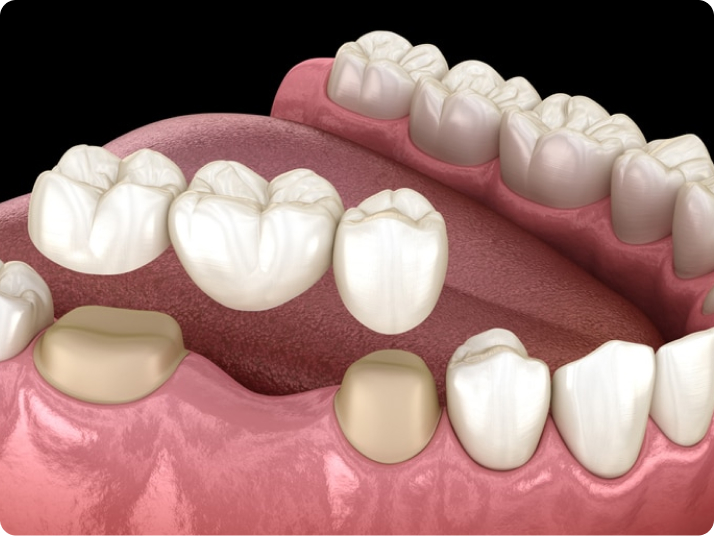
What Is a Dental Bridge?
A dental bridge is a fixed restoration that replaces one or more missing teeth, supported by the natural teeth either side of the gap or by dental implants. It typically consists of a false tooth (or teeth) fused between two supporting crowns.
Bridges are custom-made to match the colour and shape of your natural teeth and are permanently fixed in place, rather than removed for cleaning like a denture. Depending on your needs, bridges may be supported by your own teeth or anchored to dental implants.
YOUR SMILE JOURNEY
How The Treatment Works
The treatment usually follows four key stages.
01
STEP ONE
Consultation and Assessment
A clinical assessment, which may include X-rays, is carried out to check the health of the supporting teeth or gum and bone where an implant-supported bridge is being considered.
02
STEP TWO
Treatment Planning
Based on the assessment, a plan is created outlining the type of bridge, number of missing teeth to be replaced, and the supporting teeth or implants required.
03
STEP THREE
Preparation and Fitting
The supporting teeth are prepared (or implants placed, where relevant), and a custom-made bridge is fitted to restore your smile and bite.
04
STEP FOUR
Review and Aftercare Guidance
Once fitted, the clinician will check your bite and provide guidance on cleaning around the bridge to help it last as long as possible.
Why Choose a Dental Bridge?
- Replace a missing tooth with a fixed, non-removable restoration
- Restore your ability to chew and speak comfortably
- Prevent nearby teeth from shifting into the gap left by a missing tooth
- Achieve a natural-looking result matched to your existing teeth
Who May Be Suitable?
- Patients missing one or more teeth with healthy neighbouring teeth
- Patients seeking a fixed alternative to a removable denture
- Patients with adequate bone and gum health for implant-supported bridges
- Adults wanting to restore their bite and prevent further tooth movement
Important:
A clinical assessment is required to determine the most suitable type of bridge and confirm the health of the supporting teeth, gum, or bone.

When to See a Dentist
You may wish to consult a dental professional if you notice:
- One or more missing teeth affecting your bite or smile
- Nearby teeth beginning to shift into a gap
- Difficulty chewing or speaking due to a missing tooth
- Interest in a fixed alternative to a denture
A professional assessment can help determine the most appropriate treatment for you.
Frequently Asked Questions
With good oral hygiene and regular check-ups, a dental bridge can last many years, though the supporting teeth or implants should be monitored over time.
A bridge relies on the neighbouring teeth (or implants) for support and is fixed permanently in place, while a single dental implant replaces the tooth root independently and doesn't rely on adjacent teeth. Your dentist can advise which suits your situation.
The procedure is carried out under local anaesthetic, so discomfort is generally minimal. Some sensitivity around the prepared teeth is normal for a short time afterwards.
Bridges need to be cleaned daily using specific floss or brushes designed to clean underneath the false tooth, alongside regular brushing, to prevent gum problems around the restoration.